Heat pumps in Denver, CO & nearby towns
Denver Heat Pump Rebates for 2026
If a heat pump goes into your Denver-area home in 2026, you can check three programs: the Colorado heat pump tax credit discount (per the Colorado Energy Office), Xcel Energy residential heat pump rebates (per Xcel's 2026 rebate summary effective Oct. 1, 2026), and, inside city limits, the City of Denver heat pump group buy. None of them applies automatically, and none comes with a guaranteed amount. Here's what each one requires, as checked in late September 2026.
- Free installation estimate
- Insured local installer
- No obligation
Free Heat Pump Estimate
The installer sees your house, then quotes. No obligation.
Insured Local Heat Pump Installer
We connect you with one independent Denver-area installer
One Call, Not a Call List
Your details go to one installer, not a pile of sales calls
It shows up on the contractor invoice. You don't get a check in the mail.
This is how the Colorado Energy Office describes it for heat pumps installed on or after Jan. 1, 2026. A state-registered contractor claims a state tax credit for your job and must pass at least 33% of it to you. For an air-source heat pump, which is what most Denver homes get, the credit is $1,000 and your minimum discount is $333. The discount appears as a line on your invoice labeled "State of Colorado Heat Pump Discount." You don't file anything.
Read that carefully. The $1,000 goes to the contractor as a tax credit. The part you're guaranteed is $333. A contractor can pass along more, but nothing requires it.
The other 2026 amounts:
- Ground-, water- or combined-source heat pump: $2,000 credit, $667 minimum discount
- Heat pump water heater: $250 credit, $83 minimum discount
The equipment has to qualify too. It must be ENERGY STAR certified, an air-source system must be AHRI-matched (the indoor and outdoor pieces rated as a matched pair), and a space-heating heat pump must be designed to meet at least 80% of your annual heating need. That last rule is one reason a real install starts with a room-by-room load calculation (Manual J). Guessing from the size of the old furnace won't tell anyone how much of your heating the new system can handle.
Two dates matter here. If you see $1,500 quoted online, that was the 2024–2025 air-source amount, and it has expired. The amounts are also scheduled to drop again in tax year 2029.
The practical point is simple. If your installer isn't on the state registered list, the discount line never appears. Ask before you sign.
What will Xcel pay, and why does the ton matter?
If Xcel is your utility, it pays by the ton, and the way it counts tons isn't the way you might guess. The figures below come from the Xcel 2026 rebate summary for Colorado residential programs, effective Oct. 1, 2026.
| System (ducted or mixed) | Efficiency minimums | Standard | With bonus |
|---|---|---|---|
| Air-source heat pump | 15.2 SEER2, 11.7 EER2, 7.8 HSPF2 | $300 per cooling ton at 95°F | $600 per cooling ton at 95°F |
| Cold-climate air-source heat pump | 15.2 SEER2, 10 EER2, 8.1 HSPF2; COP of at least 1.75 at 5°F; capacity at 5°F of at least 70% of capacity at 47°F | $750 per heating ton at 5°F | $1,500 per heating ton at 5°F |
The regular tier counts cooling tons at 95°F. The cold-climate tier counts heating tons at 5°F. Neither one is the size printed on the box. A unit sold as a certain tonnage delivers less heat at 5°F than it does on a mild day, and Xcel pays on the 5°F number. Your installer can pull that figure from the rated performance data for the equipment. Don't do the math from the nameplate and then plan around it.
Xcel also lists rebates for ground-source heat pumps ($1,100 per heating ton standard, $2,200 with bonus) and heat pump water heaters ($750 standard, $1,500 with bonus), under the same summary.
The conditions:
- You must be an Xcel customer. Some metro addresses are served by a different utility, so check the name on your bill.
- The heat pump system rebates need an Xcel participating contractor.
- Rebate plus bonus can't exceed your invoiced project cost.
Why the Xcel bonus makes this fall a good time to get a quote
According to the Xcel 2026 rebate summary effective Oct. 1, 2026, the bonus requires an invoice dated in 2026. On the cold-climate tier, the bonus doubles the per-ton rebate. That's a real, dated reason to act. It isn't a sales line.
One exception is worth knowing. If your existing primary heat is already electric, you haven't been eligible for the bonus since Nov. 16, 2025. You can still get the standard rebate. If you're replacing a gas furnace, that exception doesn't apply to you.
A heat pump isn't a same-week purchase. Someone has to measure the house, look at the ductwork and electrical panel, and figure out where the outdoor unit can sit without getting buried by snow or dripping onto the walk. Then you have to decide between all-electric and dual-fuel, where the gas furnace stays as backup. All of that takes time. Starting in the fall gives you room to think.
An estimate is free and doesn't commit you to anything. It just tells you whether a 2026 invoice is realistic for your house. Get Free Estimate, or call (303) 529-8713.

Where did the federal credit and the income-based rebate go?
Both are off the table for most Denver homeowners in 2026. Plenty of articles haven't caught up.
Start with the federal 25C credit. The IRS page for the Energy Efficient Home Improvement Credit, last updated April 28, 2026, says you can claim it for improvements made through Dec. 31, 2025. It used to be worth up to $2,000 a year for qualifying heat pumps. A heat pump installed in 2026 doesn't qualify. If a blog post, ad or sales pitch builds a 2026 price around that credit, the math is wrong. For anything touching your tax return, talk to a tax professional. We're not one, and neither is your HVAC installer.
The other one is the Colorado Home Energy Rebates program (HEAR), which is the state income-qualified rebate. According to the August 2026 update from the Colorado Energy Office, the single-family HEAR program is closed for Region 1 and Region 2. Region 1 covers Adams, Arapahoe, Boulder, Broomfield, Clear Creek, Denver, Douglas, Elbert, El Paso, Gilpin, Jefferson, Larimer, Teller and Weld counties. So if you own a single-family home on the Front Range, you can't count on it right now. The state still lists small-multifamily HEAR and its HOMES program (manufactured and mobile homes, large multifamily) for 2026. If that describes your building, check the Colorado Energy Office page directly.
Does the City of Denver have its own rebate?
Not a cash one. As of Sept. 28, 2026, the Denver individual climate-action page doesn't list a standalone homeowner rebate for heat pumps.
What the city does offer is a heat pump group buy for qualifying Denver homeowners. The way the city describes it, you get an initial estimate first, then an installer visits your home and gives you a final quote. That order is worth noticing even if you never use the program. A number given before anyone has seen your house is a starting point, not a price.
A few boundaries:
- This is a city program. It's separate from this site, and it isn't connected to the installer we'd refer you to.
- The program covers the City and County of Denver. Aurora, Arvada, Littleton and the other suburbs aren't included just because they're nearby. The city itself tells permit applicants to confirm their parcel is actually in Denver, and the same check applies here.
For free, neutral help sorting through all this, try Power Ahead Colorado, a DRCOG program that offers free energy advisors, a contractor finder and rebate information. We can't speak for its specific amounts or eligibility rules, so ask the advisors directly.
How do the pieces stack on your project?
In plain English, and without making up a total for a house we haven't seen:
- Your contractor takes the state discount off the invoice as its own labeled line. It only happens if the contractor is state-registered and the equipment qualifies.
- You apply for the Xcel rebate through an Xcel participating contractor, and only if you're an Xcel customer. The amount depends on which tier your equipment meets and how many qualifying tons it delivers under the Xcel rating conditions.
- On top of the standard rebate, the Xcel bonus stacks if your invoice is dated in 2026 and your current primary heat isn't electric. The rebate and bonus together can't exceed the invoiced cost.
- For a 2026 Front Range install, federal 25C and single-family HEAR aren't part of the picture.
It's easiest when one installer is both state-registered and an Xcel participating contractor, so both programs run through the same job. That's not guaranteed, so ask.
Have the installer write the expected state discount and the expected Xcel rebate tier on the estimate itself, along with the exact indoor and outdoor model numbers. Then you can check the AHRI match and the efficiency figures yourself instead of trusting a verbal "you'll probably qualify." If you're leaning toward dual-fuel, ask how the design meets the state rule that a space-heating heat pump be designed for at least 80% of annual heating need.
Want to know what the equipment and installation cost before any incentives? That's on a separate page: Denver heat pump cost. We keep prices there so nobody confuses the post-rebate number from one provider with your own.
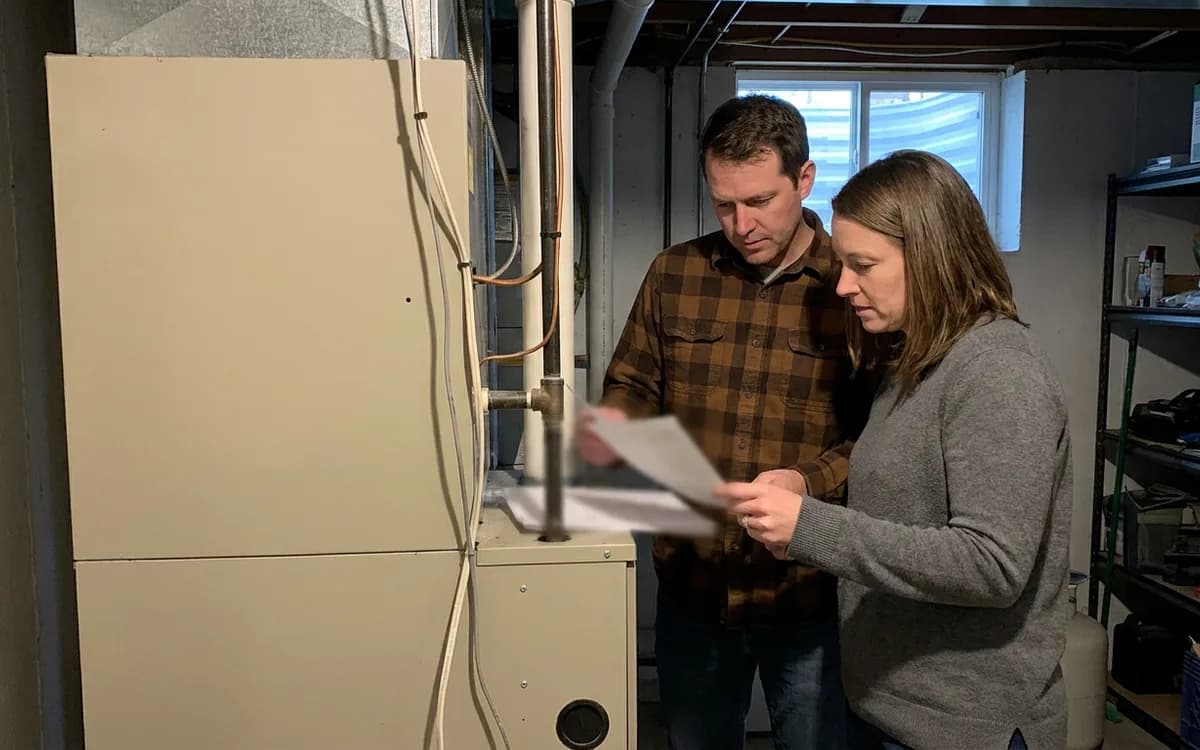
What should you ask the installer before you sign?
Bring this list to the estimate:
- Are you on the Colorado registered contractor list for the heat pump tax credit?
- How much of the state discount will you pass to me, and will it appear as "State of Colorado Heat Pump Discount" on the invoice?
- Is this system ENERGY STAR certified and AHRI-matched? What is the AHRI reference?
- Is the system designed to meet at least 80% of my annual heating need, and can I see the load calculation?
- Are you an Xcel participating contractor? Which rebate tier does this equipment meet, and how many heating or cooling tons count at the Xcel rating temperature?
- Can the job realistically be invoiced in 2026 for the bonus?
- Who applies for the Xcel rebate, you or me?
- Does my panel have capacity, or will I need a new circuit or a service upgrade?
- Who pulls the permit for my exact address? Permit rules differ from city to city and county to county. Denver, for example, licenses mechanical contractors at the city level and requires permits for mechanical work, while Colorado has no statewide HVAC license.
If an answer gets vague, write that down too.
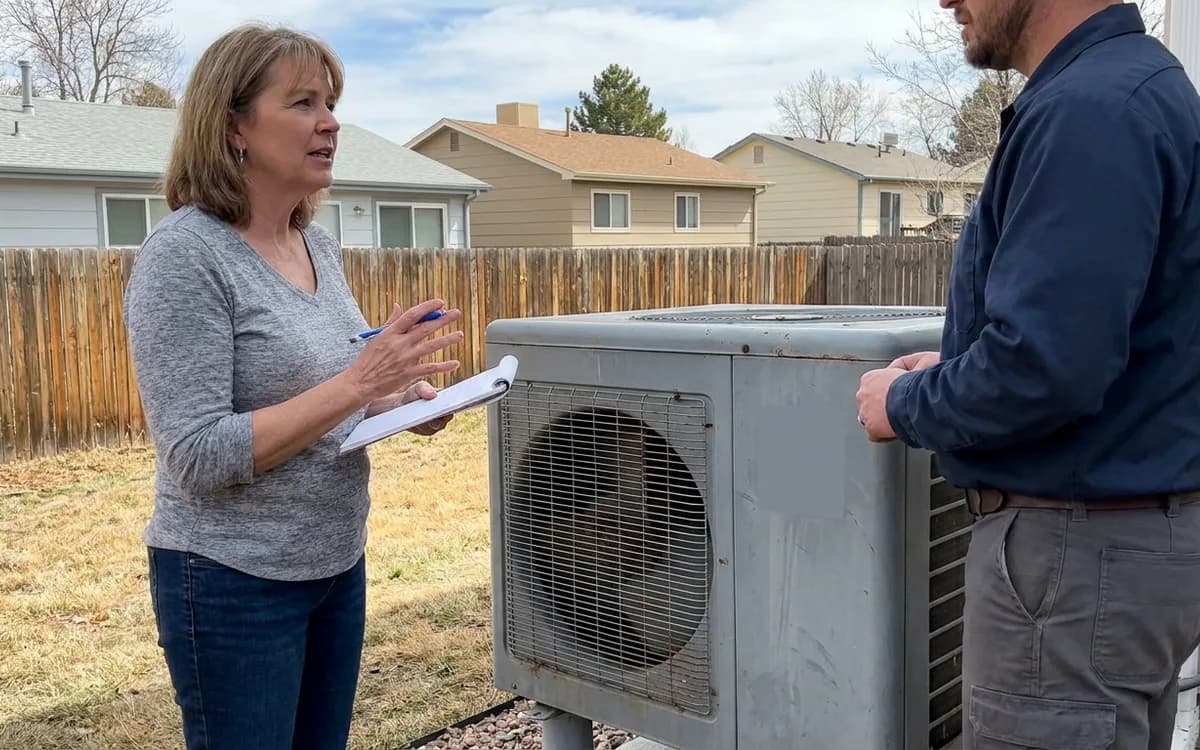
Who are you actually talking to when you call (303) 529-8713?
A referral service, not a contractor. When you call (303) 529-8713 or fill out the form, we connect you with one independent, insured local heat pump installer for a free, no-obligation estimate. We're not Xcel, the state, the City of Denver or an energy advisor. We can't approve a rebate, and we don't set the price. The installer sets it after seeing your house.
To learn more about the process, start with heat pump installation in Denver, or check the areas we serve to see whether your town is covered. When you're ready, Get Free Estimate and bring the checklist above.
Ask Away
Heat Pump Installation Questions
How much is the Colorado heat pump tax credit in 2026?
For an air-source heat pump installed on or after Jan. 1, 2026, a state-registered contractor claims a $1,000 state credit and must pass at least 33% of it to you. That makes your guaranteed minimum discount $333, according to the Colorado Energy Office. The discount shows up as an invoice line labeled "State of Colorado Heat Pump Discount," and you don't file any paperwork yourself.
Can I still get the federal heat pump tax credit for a 2026 install?
No. The IRS page for the Energy Efficient Home Improvement Credit (25C), last updated April 2026, says the credit covers improvements made through Dec. 31, 2025. A heat pump installed in 2026 doesn't qualify, even though plenty of older articles still advertise it. Check any tax question with a tax professional.
How much does Xcel pay for a cold-climate heat pump in 2026?
Per Xcel's 2026 rebate summary effective Oct. 1, 2026, a ducted or mixed cold-climate air-source heat pump that meets the Xcel efficiency minimums earns $750 per heating ton at 5°F on the standard tier. With the bonus, it's $1,500 per heating ton at 5°F. That's measured at 5°F, not from the size printed on the unit. You also need an Xcel participating contractor and Xcel service at your address.
What's the deadline for Xcel's heat pump bonus?
Per Xcel's 2026 rebate summary effective Oct. 1, 2026, the bonus requires an invoice dated in 2026. It isn't available if your existing primary heat is electric, although those customers still qualify for standard rebates. The rebate and bonus together can't exceed your invoiced project cost.
Is Colorado's HEAR rebate available in Denver?
Not for single-family homes right now. The August 2026 update from the Colorado Energy Office says the HEAR single-family program is closed for Region 1, which includes Denver, Adams, Arapahoe, Jefferson, Douglas, Broomfield and Boulder counties. Other parts of the program are listed for 2026 for certain small multifamily, manufactured and large multifamily housing.
Does the City of Denver offer a heat pump rebate?
As of Sept. 28, 2026, the City of Denver doesn't list a standalone cash rebate for homeowners. Its pathway is a heat pump group buy for qualifying Denver homeowners: you get an initial estimate, then an installer visits the home and gives a final quote. It's a city program. It isn't part of this site, and it doesn't cover the suburbs.
Is Heat Pump Installation Denver the contractor, and does the referral cost anything?
No, we're a free referral service. Call (303) 529-8713 or use the form, and we'll connect you with one independent, insured local installer for a free, no-obligation estimate. The installer sets the price after seeing your house and can tell you which incentives your project is likely to qualify for.
Thinking about a heat pump?
We'll connect you with one local, insured heat pump installer. They see the house, then set the price. No obligation to buy.